Calcific shoulder
What is a calcific shoulder?
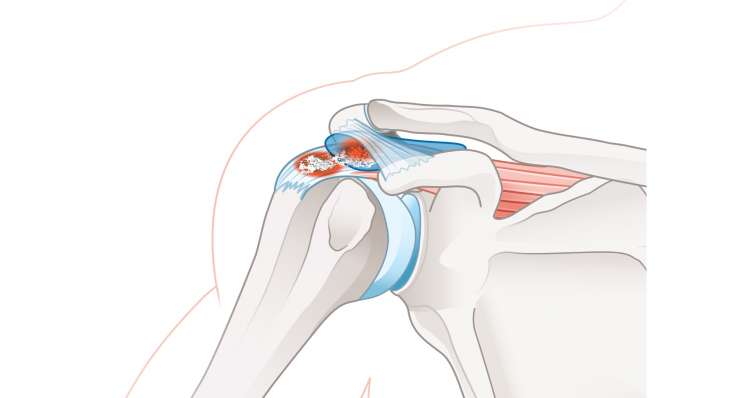
A calcific shoulder is a painful condition of the shoulder in which calcium deposits form in the tendons or bursae of the shoulder. The exact cause of this condition is unknown, but it may be related to overuse of the shoulder or injury. Typical symptoms of a calcific shoulder are pain and limited shoulder mobility. In some cases, the condition can heal on its own, while in others, treatment may be necessary to relieve pain and restore shoulder mobility.
Medical explanation
In calcific shoulder, calcium particles (carbonate apatite) are deposited in the tendons of the rotator cuff. The cause of this is still largely unknown. As the disease progresses, patients experience alternating phases of complete pain relief and severe pain. Conservative treatment involves symptomatic therapy (medication, injections) to reduce pain. Shock wave therapy can also be used to stimulate the dissolution of the calcium deposits. If conservative therapy is unsuccessful, surgical removal of the calcium deposits is possible if symptoms persist. In this arthroscopic surgery, the calcium deposits are located and the calcium is removed from the affected tendon. If a defect remains in the tendon after calcium removal, it is reattached to the bone (see rotator cuff).
In-patient stay
1–3 days
Follow-up treatment
Immediately after surgery, the arm may be moved within the pain-free range during physical therapy, which is increased over time and eventually transitions to a strengthening program.
A return to work is usually possible after 3–4 weeks. For patients who perform physical work or mainly overhead work, the rehabilitation phase is extended to approximately 6–12 weeks. In the case of large calcium deposits, follow-up treatment may take longer, as the focus is on healing the tendon (see rotator cuff). Returning to sports must be discussed individually with the surgeon.
Comprehensive information on other shoulder and elbow conditions and treatment options can be found in the complete range of treatments offered by Prof. Dr. med. Frank Martetschläger.