Shoulder dislocation
What is a shoulder dislocation?
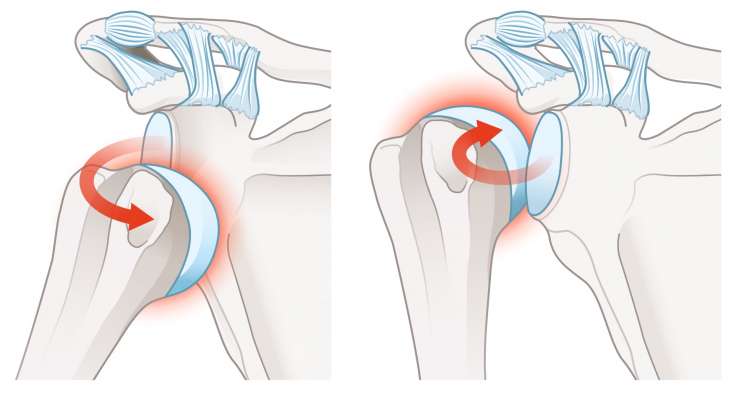
A shoulder dislocation occurs when the upper arm bone (humeral head) slips out of the shoulder socket (glenoid). This can be caused primarily by trauma resulting from a fall or a shoulder dislocation during sports. A shoulder dislocation and its possible consequence, known as shoulder instability, can lead to considerable pain and restricted shoulder mobility. Typical symptoms of shoulder instability are pain, restricted movement, and noticeable instability of the shoulder. There are different types of shoulder dislocations, with the anterior type being the most common, accounting for over 90% of cases.
Medical explanation
In the event of a dislocation or subluxation of the shoulder joint, the head of the humerus slips out of the socket, becomes jammed, and usually needs to be put back into place. This typically results in tearing of the joint lip (labrum) from the edge of the socket (Bankart lesion) and often leads to an impression fracture on the head of the humerus (Hill-Sachs lesion). Due to this structural damage and the overstretching of the capsule, young patients in particular are very likely to experience further dislocations and the joint remains unstable. In these cases, surgical stabilization is recommended to prevent early joint wear (arthrosis) due to chronic instability and frequent dislocations. In this arthroscopic surgery, the torn capsule-ligament apparatus is reattached to the bony socket with small thread anchors and the capsule is gathered. If chronic instability leads to bone defects in the humeral head/joint socket, an alternative operation to restore the bone of the socket may be necessary (Latarjet procedure or iliac crest graft).
In-patient stay
The hospital stay is approximately 2–3 days.
Follow-up treatment
The shoulder is immobilized for the first 4 weeks after surgery so that healing is not compromised. Physical therapy begins immediately after surgery with passive movement exercises, which can be increased to active-assisted movement exercises from the 4th week onwards. The resumption of professional and sporting activities depends on the individual activity. After approximately 3 months, sports without contact with opponents and overhead strain can be started; after approximately 5-6 months, these are also possible again.
Comprehensive information on other shoulder and elbow conditions and treatment options can be found in the complete range of treatments offered by Prof. Dr. med. Frank Martetschläger.