
Subacromial impingement
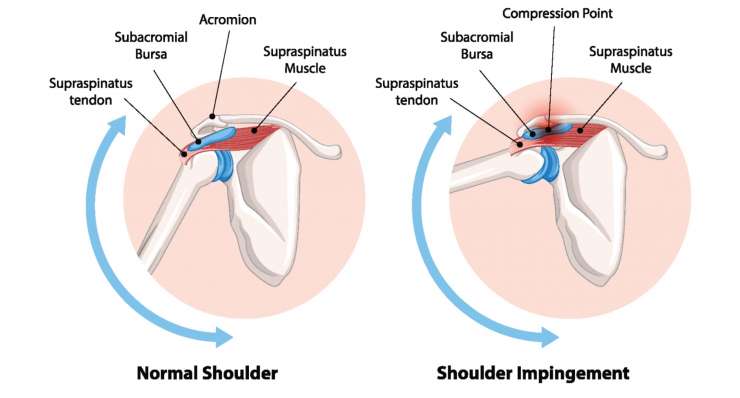
What is subacromial impingement?
Subacromial impingement is a painful shoulder condition caused by friction between the shoulder roof (acromion) and the upper arm bone (humerus). This can lead to inflammation of the structures in between (rotator cuff, bursa, biceps tendon) and thus to pain and impaired shoulder mobility. Subacromial impingement is usually caused by age-related changes.
Medical explanation
Subacromial impingement (bottleneck syndrome) refers to the narrowing of the space between the acromion/acromioclavicular joint (ACJ) and the humeral head (humerus)/rotator cuff. Bony anatomy, chronic changes (osteophytes), or osteoarthritis of the ACG can contribute to this narrowing. The constant mechanical stress on the tendon against the bone can lead to chronic irritation of the bursa and tendons (enthesopathy) or to tearing of the tendons (rotator cuff rupture).
The primary treatment is conservative and attempts to better center the shoulder downward. If conservative measures do not lead to a lasting improvement in symptoms, surgical expansion of the space can be performed to relieve the tendons and restore free gliding of the tendon under the acromion.
The treatment of choice today is arthroscopic subacromial decompression. This involves removing the inflamed soft tissue and the interfering bone.
In-patient stay
1-2 days
Follow-up treatment
Immediately after surgery, the arm can be moved within the pain-free range during physical therapy, which is increased over time and eventually transitions into a strengthening program.
In most cases, patients can return to work after 2–4 weeks. For patients who perform physical labor or predominantly overhead work, the rehabilitation phase is extended to approximately 6–12 weeks.
Comprehensive information on other shoulder and elbow conditions and treatment options can be found in the complete range of treatments offered by Prof. Dr. med. Frank Martetschläger.